People

The Teams

Storyteller

Tiare Ribeaux

Tiare Ribeaux is a Kānaka Maoli filmmaker, writer, artist and creative producer based in Honolulu, Hawai‘i. Her work tells stories around transformation and healing, centering how our bodies are inextricably linked to our land and water systems. She lets stories unfold across multiple characters and elemental forces to reimagine both our present realities and future trajectories of reclamation, restoration, and belonging. She has shown her work nationally and internationally at film festivals, in galleries and museums in multi-channel, immersive installations. She is a recipient of the Creative Capital Award, the NDN Radical Imagination Grant, the Sundance Native Lab Fellowship, and the Fourth World Media Fellowship, among others.
Vice President of the Nation of Hawaiʻi

Brandon Makaʻawaʻawa

Brandon Makaʻawaʻawa is a Kānaka Maoli leader, community organizer, and Vice President of the Nation of Hawaiʻi. He leads large-scale land and food system restoration efforts in Waimānalo, and represents Hawaiʻi at international forums such as the UN Permanent Forum on Indigenous Issues. His work bridges policy advocacy, education, and regenerative development rooted in Kānaka Maoli ancestral knowledge and long-term community self-determination.
Creative Technologist

Daniel Kinzer

Daniel Kinzer is a Hawaiʻi-based educator and ocean advocate with 20+ years co-creating thriving, regenerative communities through digital innovation, storytelling, and place-based learning. He is a Biomimicry Professional whose work has concentrated on marine ecology and innovative solutions to climate change and ocean-related challenges. He has led sustainability programs at Hawaiʻi Technology Academy, worked with the Polynesian Voyaging Society, and National Geographic. Through Pacific Blue Studios, he connects youth, place, and technology to build resilient futures across Hawaiʻi and the Pacific.

AHUPUA'A LIVING LAB

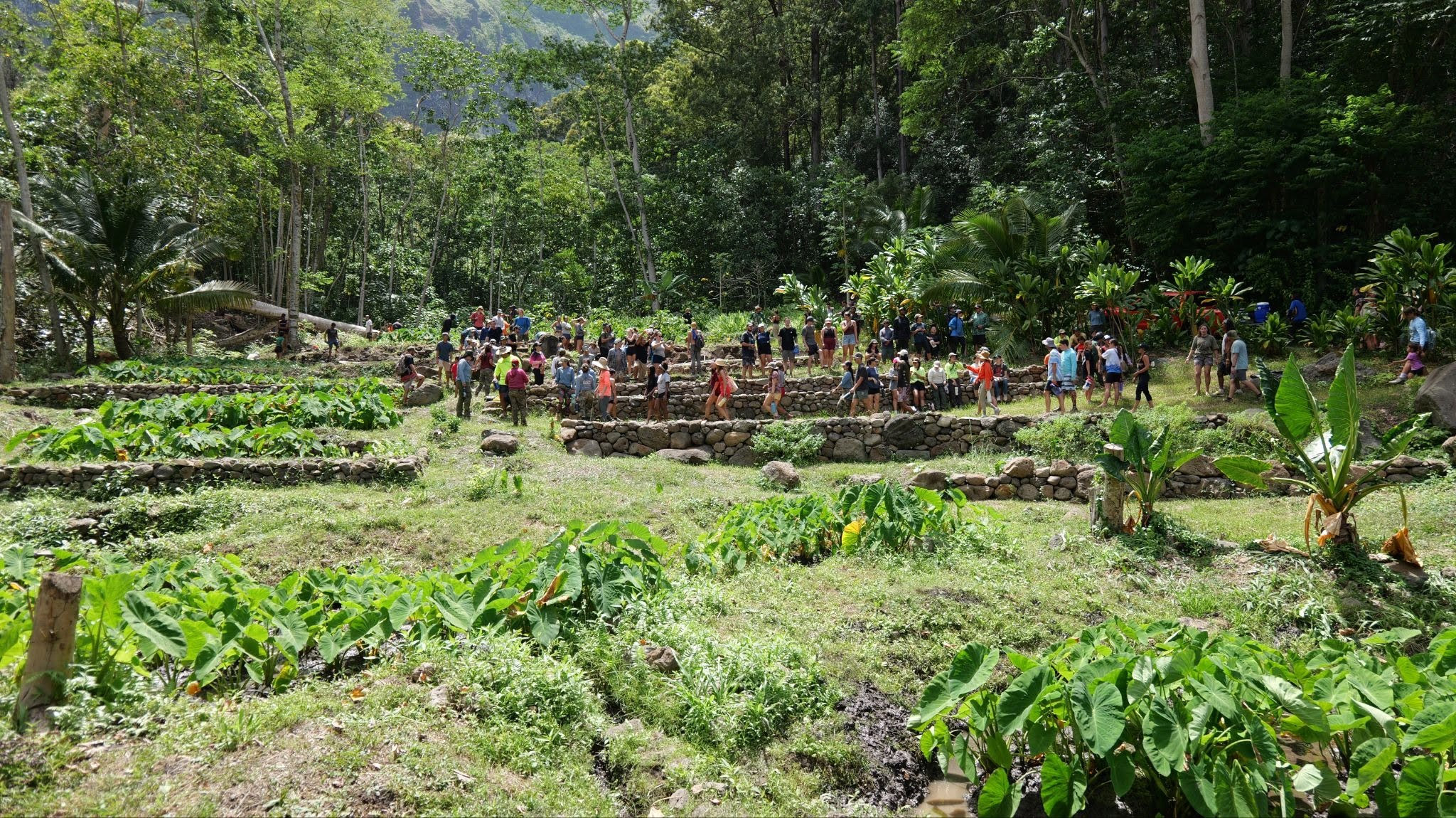
The Ahupuaʻa Living Lab is an interactive spatial storytelling and restoration platform rooted in the living landscape of Puʻuhonua ʻo Waimānalo, on Oʻahu, Hawaiʻi to restore relationships between people, water, and ʻāina (land), offering a model of climate resilience rooted in ancestral lifeways. Centered on more than 100 loʻi kalo terraces and extending across the full ahupuaʻa (from the mountains to the ocean) the project combines LiDAR, photogrammetry, drone imaging, historical maps, environmental sensor data, and moʻolelo (stories) to create an immersive living model of Puʻuhonua ʻo Waimānalo and the broader ahupuaʻa that surrounds it.

This platform will help guide the restoration of waterways, loʻi (kalo terraces), fishponds, native food forests, and cultural sites while making visible the intelligence embedded in kūpuna-designed systems. Grounded in Kānaka Maoli epistemology and the practice of kilo (deep observation), the project is both a practical restoration tool and a visionary communication platform: a space for education, community participation, and future world-building that reconnects people to ʻāina, strengthens sovereignty, and models regenerative climate futures.
Creative Technologist

Chipo Mapondera

Chipo Mapondera is a Creative Technologist, exploring her Zimbabwean lineage through an intersection of African heritage and immersive technology. Her work channels the ancestral continuum through technologically-facilitated embodied storytelling, sonic environments and ancestral knowledge, creating space for speculative futures rooted in deep traditions. Drawing on ritual, ceremony and other Indigenous technologies, Chipo’s work synthesises tradition with multilayered, diasporic artistic expression, offering contemporary portals into ancestral memory and ways of knowing. Winning the 2024 Innovate UK Career Breakout Award, Chipo has been nominated for major awards including the 2025 BFI & CHANEL Filmmaker Awards, the 2025 Fakugesi Awards, and the 2024 AIXR Social Impact Award. Selected for leading international programs, including NEW INC at the New Museum in New York, S+T+ARTS Afropean Intelligence Residencies and CPH:LAB, Chipo’s work has been presented internationally at CPH:DOX, NewImages Festival, Hypha Studios London, Cheng Kar Shun Digital Hub Oxford, Fak’ugesi, and the National Gallery of Zimbabwe.
Disaster Management Sciences Practitioner

Thania Matamande

Thania Matamande is a qualified Disaster Management Sciences practitioner whose work promotes safe, resilient and environmentally and culturally-aware communities. Born and raised in Zimbabwe, she has worked with communities to develop skills and knowledge in Indigenous Knowledge Systems, culture and diversity, climate change, environmental management and agriculture and landscape management. Working at Viable Action as the Programme Manager has also allowed Thania to gain expertise that has enabled her to facilitate learning amongst youths. Her work supports dialogues between elders and youth, creating space for the intergenerational transmission of Indigenous Knowledge Systems that are at risk of being lost. Through her previous research Thania gained skills in the technical application of Geographical Information Systems (GIS), Remote Sensing and Artificial Intelligence, particularly the use of Landsat 9, the Random Forest algorithm and GIS to assess the impacts of climate change. Her experience demonstrates that sustainability is achievable, particularly when communities come together to build a future that is resilient and free from disaster and environmental harm.
Storyteller

Owen Tafadzwa Chirikure

Owen Tafadzwa Chirikure is a Zimbabwean journalist, documentary filmmaker, and Director of Photography based in Mutare, Manicaland Province. He is the creative force behind Kreative Studios, where he delivers high-end visual storytelling and technical cinematography. His portfolio spans complex documentary projects and commercial media production, characterised by a sophisticated command of lighting and narrative structure. In addition to his media career, Chirikure is a prominent figure in Manicaland’s agricultural sector. As an active farmer practicing sustainable approaches in the Province, Owen is embedded in the community that his work serves. One of his most recent projects is a YouTube channel that shares engaging content about sustainable farming experiences through documentary and interviews. This project contributes to the sustainable farming movement and supports community perspectives in this space. This platform was created as an information hub for young and old farmers to share knowledge and experiences. The platform’s following of 21K subscribers demonstrates documentary and video storytelling as an effective, low-literacy format for intergenerational knowledge transmission. Owen remains committed to professional excellence and the mentorship of emerging creators within the Manicaland province.

KUCHEMA XR

KUCHEMA XR is a community-led immersive project integrating Indigenous knowledge and agroecology practices to support climate adaptation, ecosystem restoration and intergenerational environmental stewardship in Chimanimani, Zimbabwe. The project integrates XR tools into programmes that promote agroecology, water conservation, soil restoration and disaster risk reduction, by bridging ancestral practices and digital tools to foster community-led environmental stewardship and scalable approaches to climate adaptation. Using 3D modelling, VR and 360 storytelling, the project creates a culturally rooted, embodied and experiential environment that enables youth and communities to engage with ancestral practices and sustainable climate futures.

Storyteller

Alysha Nelson

Alysha Nelson is an immersive producer whose practice sits at the intersection of XR, live art, and ecological equity. Using technology to serve the community, her work centers non-Western epistemologies that institutional storytelling refuses to tell.
Forester

Adi Gangga

Adi Gangga is a researcher, forester, and community organiser with over a decade of experience working with the local communities across Indonesia. His practice spans community-based climate adaptation and mitigation, local governance, and green infrastructure. Over the last four years, his work has focused on peatland ecosystems in West Kalimantan, which play a key role in achieving global climate goals. His work combines applied research on emission reductions with community development to restore and protect peatland as well as mitigate peatland fire and strengthen community resilience.

PARU

PARU is an interactive place-based documentary grounded in a decade of peatland field research that structures the transboundary haze crisis as a series of decisions and exchanges by exploring impossible economic choices facing smallholder farmers in West Kalimantan. Through a series of collective decisions and exchanges, it reimagines game mechanics within a live sensorial environment: projection mapping onto organic surfaces, spatial audio, farmer testimony, field recordings. Unlike traditional documentaries, viewers cannot observe from a distance. They must contribute before they receive. The experience culminates with the group unlocking a space that cannot exist unless they make it: a collective reimagining of futures that could exist instead.

Director

Alexandra Marin

Alexandra leads the Living Lab for Immersion at the Society for Arts and Technology (SAT), launching an experimental co-creation hub that leverages immersive technologies for social impact. She has a strong understanding of technological and production processes in the cultural and artistic sectors, with over eight years of experience in the field. In 2022, she joined the SAT research team as a project manager, where she leads R&D initiatives in collaboration with creative studios and artists. With expertise in digital arts and training in political science and project management, she brings a holistic perspective on current issues related to creation, innovation, and social transformation.
Creative Technologist

Manuel Bolduc

Manuel Bolduc is a Research Developer at the Society for Arts and Technology (SAT). He holds a Master’s degree in Applied Mathematics from McGill University, and his work focuses on the application of algorithms and machine learning within the field of human-computer interaction (HCI). In his role at the SAT, Manuel contributes to various immersive projects, moving from initial proofs of concept to full-scale deployments. He is responsible for designing interactive pipelines, drawing on his background in computer vision and sensing technologies to support the creation and implementation of immersive experiences.
Anthropologist

Sandrine Lambert

Sandrine Lambert is an anthropologist and a Postdoctoral Researcher Fellow at Concordia University (Ethnography Lab and Milieux Institute for Arts Culture and Technology) in Montreal. Her research investigates energy and governance issues of data centers, mainly in Montreal, and the sociotechnical imaginaries shaping digital infrastructures. She holds a PhD in Anthropology from Université Laval (Quebec city), where her doctoral research examined fablabs, urban utopias, and citizen participation in digital fabrication spaces in Barcelona.

CLOUDS ARE MASSING

Clouds are Massing is a living laboratory for citizen participation, using a location-based immersive experience and data storytelling to engage the public in the planning of a future data centre in Montreal, through speculative design. As a space for collective reflection, the Clouds are Massing leverages immersive data storytelling to empower citizens’ deliberative processes. Through knowledge harvesting and the reingestion of community-generated insights, the experience evolves upon different iterations. This approach intentionally questions established power structures in urban development, repositioning the digital and physical territory as a collaborative space for public agency and multi-perspective discourse.

Keynote

The Collective Mapping of IMAGINARY ATLAS: AMAZÔNIA In Belém do Pará, the heart of the Brazilian Rainforest

Wednesday, May 27, 2026, 12 noon -1:30 pm ET

The Collective Mapping of IMAGINARY ATLAS: AMAZÔNIA

How do we imagine futures that do not erase the places they emerge from? This keynote explores a place-based approach to imagining climate futures through immersive media, traditional knowledge, and co-creation.

Drawing from The Imaginary Atlas, Amazônia, an ongoing project developed through fieldwork and collaborations in the Amazon rainforest, it reflects on how storytelling, interactive installations, and emerging technologies can be shaped by local knowledge systems and cultural practices.

Rather than proposing universal futures, the work focuses on building situated narratives through workshops, collective worldbuilding, and embodied experiences. The talk discusses how combining different forms of expression (from TEK to emerging tech) can open up new ways of prototyping futures that are more plural, grounded, and connected to lived realities.

Gabriela Bilá

Gabriela Bilá is a Brazilian architect, artist, and researcher at the MIT Media Lab, where she explores how immersive media and speculative storytelling can help imagine more locally grounded urban futures. Working at the intersection of art, technology, and urbanism, her practice combines XR, film, and participatory workshops to co-create future narratives with communities across diverse geographies. She is the creator of The Imaginary Atlas, an evolving body of immersive installations that investigates climate adaptation, cultural knowledge, and emerging technologies as tools to reimagine cities. Through teaching and collaborative research, her work positions fiction as a method to engage collective imagination and shape alternative climate futures aligned with lived realities.

Diogo Pinto

Diogo Pinto is Director of New Technologies and In-Camera Visual Effects at Quanta. His work focuses on real-time visualization, virtual production, XR, and interactive design, developing systems and experiences that connect cinema, visual arts, immersive technologies, and spatial storytelling. He has collaborated with Netflix, HBO, Amazon Studios, and GloboPlay, and has exhibited installations at CCBB, EXPO Milano, and the Museum of the Portuguese Language

Registration for the zoom livestream is now open.

Register

Organizing Team

Director, WORLDING, Co-Creation Studio MIT

Kat Cizek

Katerina Cizek is a Peabody and two-time Emmy-winning documentary director, creator and leader in the emergent tech and media space. She is the Artistic Director of the Co-Creation Studio at MIT Open Documentary Lab where she is lead author (with Uricchio) of the MIT Press book Collective Wisdom: Co-Creating Media for Equity and Justice, in 2022. For over a decade at the National Film Board of Canada, she helped redefine the organization as one of the world’s leading digital story hubs with two major projects HIGHRISE, and the NFB Filmmaker-in-Residence. Cizek‘s earlier independent films include the Hampton-Prize winner Seeing is Believing: Handicams, Human Rights and the News (with Peter Wintonick). She has served  as an advisor to Sundance Institute Labs and is currently chair of the Peabody Board of Jurors for Interactive. Cizek is a settler living in Tkaronto (Toronto), while working at MIT.
Co-Director, WORLDING. Founder at Algae

Srushti Kamat

Srushti Kamat is the co-director of WORLDING + founder of Algae, a Singapore-based startup building a new ecosystem for financing, developing and distributing creative technologies. Algae was incubated at NEW INC Y11, the New Museum of Contemporary Art’s incubator and launched at DEMO 2025. Algae has received XR project grants from Singapore’s Ministry of Sustainability and Environment and partnered with University of Florida’s Digital Worlds Institute, the WWF and other organizations on climate technology initiatives. Srushti graduated with a Masters of Science in Comparative Media Studies from MIT in 2022 with a thesis on virtual production. At MIT, she received the PKG fellowship to grow early iterations of Algae and was a fellow at the MIT Center for International Studies. She also holds a Bachelor of Arts in History and Journalism from the University of Oregon, where she was an ICSP scholar, a fellow at the Oxford Consortium for Human Rights and co-led experimental media projects that went on to win Hearst Journalism Multimedia Awards among others.
Principal Investigator, MIT Open Documentary Lab

Caesar McDowell

Ceasar McDowell is a Professor of the Practice of Civic Design at MIT. Ceasar teaches on civic and community engagement and the use of social technology to enhance both. His current work is on the design of civic infrastructures and processes to connect the increasingly demographically complex public. He co-hosts the WeWhoEngage a podcast series on civic design. Ceasar brings his deep commitment to the work of building beloved, just and equitable communities that are able to – as his friend Carl Moore says – ”struggle with traditions that bind and the interests that separate in order to build a future that is an equitable improvement on the past.”
MIT Research Scientist

Rachel Connolly

Rachel is a MIT Research Scientist in the department of Aeronautics and Astronautics. She works with NASA Science as the Systems Integration and Analysis lead for NASA’s Science Activation program. Her work focuses on designing media and technology-integrated experiences that leverage scientific data for engagement and learning in the Earth and Space sciences. Her background is in Astrophysics and her PhD is in Science Education from Columbia University. Prior to joining MIT in 2020, Dr. Connolly was the director of STEM education for WGBH and PBS Learning Media, and before that the Astrophysics Education Manager at the American Museum of Natural History’s Hayden Planetarium. She has also been a planetarium director and a high school physics teacher in New York City. She lives in Boston where she plays video games with her son and loves music, cooking, and helping people stargaze.
Urban Practitioner, Master in City Planning at MIT

Temuulen Enkhbat

Temuulen Enkhbat is an urban practitioner and civic designer from Mongolia, pursuing Master in City Planning (MCP) program at MIT. Her work focuses on finding innovative solutions to urban planning and climate resilience challenges in informal settlements through community co-design, youth engagement, and policy advocacy. Before graduate school, she worked as a Program Lead at GerHub, a social innovation nonprofit based in Ulaanbaatar, Mongolia. There, she led social and environmental impact initiatives focused on renewable energy transition, climate resilience, and informal settlement upgrading, working to amplify community voices in decision-making processes.

Advisors from Agog

Executive Director and Co-Founder

Chip Giller

Chip Giller is the executive director and a co-founder of Agog. He has been a visionary in the climate space and media field for 30 years, leading creative storytelling teams and partnering with nonprofits, philanthropists, and other leaders to accelerate progress to a better, more just world. In 2024, Chip joined forces with Wendy Schmidt to launch Agog: The Immersive Media Institute, bringing their shared passion for innovation and social change to the forefront of the immersive media landscape. Agog helps people use emerging media like XR to imagine and build better futures. In 1999, Chip founded one of the first digital news organizations and first nonprofit newsrooms, Grist, to engage the next generation on climate change and other environmental issues. Grist reaches millions and has been recognized in many ways for its impact, including as a recipient of the National Magazine Award for General Excellence.
Chief of Programs and Strategy

Amy Seidenwurm

Agog Chief of Programs and Strategy Amy Seidenwurm is a globally recognized innovator and technology leader. Prior to joining Agog, she founded ANTLER, a consultancy that deploys immersive experiences for social good. Previously, she created VR experiences as executive producer of Meta’s VR for Good initiative. Amy has produced award-winning VR projects that have been selected for more than 50 festivals and social good events, including Sundance, SXSW Film, Tribeca Film Festival, Skoll World Forum, Venice Film Festival, The Nobel Peace Museum, and the UN General Assembly. She received a Peabody Award as executive producer of You Destroy. We Create | The war on Ukraine’s culture. At the Los Angeles Philharmonic and The Hollywood Bowl, she produced digital projects, including a traveling orchestral VR experience called VAN Beethoven that brought classical music and VR to underserved arts communities. Earlier in her career, Amy spent time as a record industry executive at Elektra, Virgin, and Sub Pop.
Program Manager

Jasmin Askew

Program Manager Jasmin Askew brings over a decade of experience in social impact marketing, program development, and strategic partnerships. Before joining Agog, she led Unity for Humanity, championing XR creators using immersive technology for positive change. During her time at Unity, she also consulted for Black Terminus AR, advancing accessibility in XR creation. Previously, she worked at Black Hat to promote inclusivity and sustainability in cybersecurity. She also volunteers with Change to Come, supporting families in Oakland, California. At Agog, Jasmin continues her mission of harnessing emerging technology to drive community empowerment and capability enhancement.
Community Strategy & Engagement Manager

Vanessa Lawand Pfeiffer

Vanessa has dedicated her career to fostering community and driving social impact through media and entertainment. She brings over 15 years of experience in film, TV, music, gaming, and digital content to her role as Agog’s Community Strategy & Engagement Manager. Previously, Vanessa served as Director of Equity & Inclusion at Warner Bros. Discovery, leading talent pipeline programs in animation, games, VFX, and creative tech. She blends deep industry expertise with a commitment to representation, innovation, and sustainable impact. She is originally from Montreal and is now based in Los Angeles.
Head of Production

Mary Matheson

Head of Production Mary Matheson is a multi-award-winning immersive director and producer known for using XR storytelling to drive social impact. With a background in journalism and over two decades of experience in documentary filmmaking, she has created work for clients including NASA, Google, the United Nations, and Save the Children. Her films have been broadcast on major networks and featured at global events such as the UN Climate Change Summit, SXSW, and Sheffield DocFest. Mary’s interactive VR experience on the Yazidis in northern Iraq earned the 2022 VR Award and 2023 Telly Award for Social Impact. Her documentary Walk to Westerbork was part of the award-winning series The Journey Back. She is passionate about mentoring the next generation of immersive creators and helped found the Narrative & Emerging Media program at Arizona State University’s Los Angeles campus. At Agog, Mary leads production with a focus on impact, innovation, and untold narratives.

MIT Exploration Team

Samantha Eddy

Yá’át’ééh! Samantha Eddy (she/her) is a Diné researcher and designer, who is currently a Master of Architecture Candidate at MIT. Experiencing the urban fabric disparities between the city and reservation has led to her interest in using architecture as a tool to strengthen her Diné community. My work is at the intersections of architecture, community action research, and intergenerational knowledge. Samantha have worked with Nááts’íilid Initiative, a Community Development Collaborative building sweat equity homes and other infrastructural developments in various regions in the Navajo Nation.

Simone Delaney

Simone Hope Delaney (they/them) is a multidisciplinary designer interested in intersections of race, space, ecology, and sound. A recent graduate of MIT DUSP’s Master in City Planning program, they have a transdisciplinary background in architecture, landscape architecture, and planning, through which they have contributed to climate adaptation projects in San Francisco, New York, Louisiana, Florida, and Jakarta. As a descendant of freedom seekers that fled to so-called Canada, their research interests include fugitive landscapes, Maroon legacies, Black Traditional Ecological Knowledge (BTEK), Black-Indigenous interrelationality, and climate disaster collectivism. Currently, they are contributing to a reparative planning program for African Nova Scotian settlements in Halifax Regional Municipality. As part of the Sunsum Collective, they are also a Design Guide for the Enslaved African Burial Ground at Van Cortlandt Park in the Bronx, through which they are exploring what it means to design sacred spaces at sites of encounter between the living and the dead.

Will Jones

Wil Jones (he/him) is a designer, urban planner, and technologist working at the intersection of spatial data, community infrastructure, and cultural preservation. A graduate of MIT DUSP’s Master in City Planning program, his work explores how participatory mapping, digital platforms, and immersive environments can support communities navigating climate risk, displacement, and the loss of cultural memory. With a background spanning civic technology, public-sector planning, and community-based practice, Wil leads projects that incorporate hyperlocal knowledge into actionable tools for preparedness, advocacy, and long-term stewardship. As a founding Principal at GROUND3D, he has supported neighborhood-scale resilience strategies, environmental justice mapping, and the development of community-owned data systems.

For the first time, WORLDING includes an MIT Exploration Team made up of an MIT Architecture (SA+P) graduate student and two recent Urban Planning (DUSP) alums. Under the guidance of Principal Investigator Professor Ceasar McDowell, they will attend and work with the WORLDING organizing team to explore how the initiative might further align with the MIT DUSP and SA+P student experience.

Alum Panels & Case Studies

ALUM PANEL: CO-CREATION AND WORLDING, 2023 ALUM

Amy Louise Wilson

Amy Louise Wilson is an artist, writer and performer from Johannesburg. Since 2019 she has been practicing as part of the artist duo Lo-Def Film Factory, together with Francois Knoetze. Their work involves archival research, dramaturgy, and visual strategies associated with video art, collage, sculptural installation and new media. It began as a mobile, amateur filmmaking workshop which co-created and screened experimental video in public spaces. Since then, the duo’s practice has embraced elements both formal, like installations and videos – and theoretical, like workshops. Central to their practice is a commitment to working with young people in open-ended research-creation processes, to explore and create space for D.I.Y, collaborative and experimental storytelling. Their projects probe the intersections between local contexts, extractive economies, and global technological systems – using lo-fi aesthetics to expose high-stakes realities. 

Kyle Marais

Kyle Marais is a South African new media artist and creative technologist whose work is rooted in collaboration across art, technology, and social inquiry. He holds an MSc in Computer Science, and his practice spans XR, immersive storytelling, and creative computation. He has worked with a diverse range of collaborators through shared making and experimentation. Most recently, in 2025, he was part of the Emerging New Media Art residency at Diriyah Art Futures. Fisherchild, the project incubated by Worlding 2023, received a S+T+ARTS Prize Award of Distinction in 2025, and he was also the recipient of the Special Jury Award for Creative Technology at IDFA DocLab 2023 alongside artist Natalie Paneng. Currently, he is collaborating with South African cultural institutions including the Robben Island Museum and Iziko Museums of South Africa.

Traci Kwaai

Traci Kwaai is a sixth generation fisher child of the indigenous fishing community of Kalk Bay. She is a storyteller, activist, teacher and entrepreneur who leads the powerful and impactful “Walk of Remembrance” focusing on the history and marginalisation of her community who have lived in Kalk Bay for more than 300 years.

TEAM: FISHER CHILD

FISHER CHILD is a new media project which translates the oral storytelling archive of a small South African fishing community into a digital repository of indigenous marine knowledge, layering transoceanic and digital surfaces. It exists as VR and AR experiences alongside a community kitchen project.

ALUM PANEL: CO-CREATION AND WORLDING, 2023 ALUM

Gayatri Parameswara

Gayatri Parameswaran is an Emmy-nominated, Peabody-winning writer, director and producer of immersive works. She was born and raised in India and is currently based in Berlin, where she co-founded NowHere Media — a storytelling studio that views contemporary issues through a critical lens. Gayatri’s artistic practice lies at the intersection of storytelling, technology and societal impact. Her work has been exhibited at the Venice International Film Festival, Tribeca Film Festival, SXSW, IDFA, Festival de Cannes, United Nations and beyond. She is a Sundance New Frontier alumnus, has won the Tribeca Storyscapes Award for Best Immersive, SXSW Best Use of Immersive Arts and the Lumiere Award for Best VR documentary among other accolades. Gayatri is a guest lecturer at universities such as the Freie Universität (FU) Berlin, Hochschule für Medien, Kommunikation und Wirtschaft (HMKW), Filmakademie Baden-Württemberg and Züricher Hochschule der Kunst (ZHdK).

TEAM: Shan | Among humans, saints and snow leopards

Shan | Among humans, saints and snow leopards is a mixed reality experience set in the high Himalayas, where the lives of Tsering Palmo, a resilient shepherdess, and Tsewang Norbu, a wildlife spotter, are interwoven with the elusive snow leopard. Through augmented and virtual reality, participants journey into the heart of Ladakh, navigating the challenges of this fragile ecosystem where human survival, wildlife conservation, and climate change intersect.

CASE STUDY: WAVES OF BUFFALO, WORLDING 2022 and 2025 ALUM

Dr. Tasha Hubbard

Dr. Tasha Hubbard (Cree) is a filmmaker and an associate professor in the Faculty of Native Studies and the Department of English and Film at the University of Alberta. She is from Peepeekisis Cree Nation in Treaty Four Territory and has ties to Thunderchild Cree Nation in Treaty Six Territory. Her feature documentary nîpawistamâsowin: We Will Stand Up opened Hot Docs in 2019, won Best Canadian feature, and won the Canadian Academy Screen Award for Best Feature Documentary. She was also recognized by the Director’s Guild of Canada with the Discovery Award in 2019. She is active in the rematriation of buffalo to the plains ecosystem in alignment with the Buffalo Treaty. Her latest feature documentary, Singing Back the Buffalo, was released in 2024. Her newest project is called Meadowlarks. It is her first scripted feature, premiering at the Toronto International Film Festival in fall of 2025.

Jason Ryle

Jason Ryle is a film curator and producer of film, TV, and XR. He is currently an International Programmer for the Toronto International Film Festival (TIFF), focusing on films from the UK, Ireland, Australia, New Zealand, and Global Indigenous Cinema. Jason also is part of the International Selection Committee for FilmFest Dresden. From 2010 to 2020, he served as the director of imagineNATIVE Film + Media Arts Festival, the world’s largest showcase of Indigenous-made screen content. His work as a producer has earned him nominations for the Independent Spirit Award and the Canadian Screen Awards, and in 2021 he was given the Clyde Gilmour Award from the Toronto Film Critics Association, which is bestowed to Canadians whose work has in some way enriched the understanding and appreciation of film in their native country. His most recent works as a producer include the animated feature documentary ENDLESS COOKIE (d. Pete & Seth Scriver) and the dome-based XR work WILFRED BUCK’S STAR STORIES (d. Lisa Jackson).

Emma Hamilton

Emma Hamilton (she/they) is a director, creative producer, and multidisciplinary artist shaping the future of immersive storytelling. Emma’s career includes pivotal roles at pioneering studios such as Marshmallow Laser Feast and DVgroup, where they helped craft groundbreaking experiences that blur the boundaries between art, technology, and audience.

TEAM: WAVES OF BUFFALO

WAVES OF BUFFALO How do we move beyond stories that hold buffalo in the past, and instead envision a future in which great herds return?

“To accomplish this, it is necessary for all who are committed to decolonial transformation and the generation of anti-colonial worlds to continue imagining buffalo as key to our future ways of life, rather than solely a story of trauma or loss situated in the past.”
  – Maddi Burns, Gina Starblanket, Melissa Arcand

In this talk, Tasha Hubbard, Jason Ryle, and Emma Hamilton share the evolving trajectory of WAVES OF BUFFALO, a transdisciplinary project emerging from the feature film SINGING BACK THE BUFFALO (2024). Reflecting on their experience at Worlding, they discuss how the work has grown beyond the screen into a land-based, site-specific practice, and consider the opportunities and challenges of developing a large-scale durational installation.

The presentation will introduce the project’s immersive form – interweaving sensory storytelling techniques with mixed reality technologies, spatial sound, and physical installation – while outlining its core intentions: to reframe dominant narratives of the “empty prairie” and conservation; to centre Indigenous knowledge and storytelling; to explore the buffalo’s relationships with the many living systems they sustain; and to engage participants in the process of earning knowledge through time, movement, and attention.

The artists will also speak to the project’s current stage of development and their goals for the coming year, including advancing Buffalo consciousness and rematriation, and fostering deeper appreciation and support for grassland ecosystems.

Opening Keynote

COMMUNITY-BASED DIGITAL TWINS

City Science Lab, Hamburg Germany

Prof. Gesa Ziemer

Gesa Ziemer (Prof. Dr. Phil.) is director of the City Science Lab, a collaboration with the MIT Media Lab in Cambridge/USA and academic lead of the technology and innovation lab UNITAC for the United Nations (with UN Habitat, UN-OICT). She is professor of Digital Urban Cultures at the HafenCity University Hamburg. Her research is focused on new forms of data-based collaboration for citizens and experts, international city and regional development centering on urban technologies for informal settlements and artistic practices for urban research.

Keynote

NVIDIA’S EARTH-2

NVIDIA

Karthik Kashinath

Karthik is a cross-disciplinary leader in NVIDIA’s Earth-2 initiative, focusing on large-scale generative AI and HPC technologies for weather and climate science applications. He works across strategy, research, full-stack engineering, product development, and product deployment. Prior to joining NVIDIA, he worked as a scientist at Lawrence Berkeley Lab in Climate and Computing sciences, specializing in physics-informed machine learning for complex systems. He is trained as an engineer with a Bachelors from the Indian Institute of Technology, Masters from Stanford University, and PhD from the University of Cambridge, U.K..

Meet the Advisors

Mentor for Kuchema XR

Beata Calińska

Beata Calińska (she/her) is the Associate Director of Digital Innovation at The Music Center in Los Angeles, where she curates projects at the intersection of arts and technology. From 2019 to 2024, she managed programs at the Sundance Institute, overseeing New Frontier Labs and Festival exhibitions. The digital venue she produced, The Spaceship for the 2022 Sundance Film Festival, received a Webby Award. She is a hosting organizer for the Royal Shakespeare Company’s Interdisciplinary Fellowship and has served as a mentor, juror, and program advisor for institutions including Tribeca Immersive, IDFA Doc Lab, DOK Leipzig, and Cubaverso XR Lab in Havana. She is also part of the Cannes Curator Network 2025–2026. She recently produced work for LACMA’s Art + Technology Lab. Currently, she advises initiatives at USC and UCLA. Her documentary work has been presented internationally, and she has been a fellow artist with organizations such as the Goethe-Institut and UnionDocs Center for Documentary Art.
Mentor for Paru

Ryat Yezbick

Ryat Yezbick (they/them) is a visual artist who uses their training in cultural anthropology to inform the issues they tackle as a maker. Yezbick investigates technology’s impact on group identity, morals, and collective memory through public archives and collaborations. Figuring their lived experience in their work, they address a complex set of questions around security, gender, home, family, love, violence, power, and responsibility in the era of digital surveillance and decentralized global conflict. They work in a variety of mediums – notably live performance, experimental documentary, installation and new media – that have garnered support from audiences and curators internationally. They are a published author, multi-time grant recipient, and academic in the Narrative and Emerging Media (NEM) Program at Arizona State University (ASU). Their most recent exhibitions include a solo show at Reisig and Taylor Contemporary (Los Angeles), New Images (Paris), and Tribeca Immersive (New York).
Mentor for Clouds are Massing

Joanna Wright

Joanna Wright (she/her) is a Welsh documentary artist, curator,  and creative producer. Her projects are often long-term collaborations with communities, archive collections, and scientists that re-examine established narratives and relationships between people, place, environment, and time. Projects she has collaborated on have been presented internationally, including at Ars Electronica, CPH:DOX, SXSW, National Gallery London, ICA, True/False, The Space, IDFA and UNESCO.  She has published on accessibility in creative digital work, and on the intersections of documentary,  technology and innovation in small-nation contexts.  An alumni fellow of the Open Documentary Lab & Co-Creation studio, she is currently lead for immersive, digital and interdisciplinary arts at Cyngor Celfyddydau Cymru – Arts Council Wales.
Mentor for Ahupuha’a Living Lab

Max Musau

Max Musau (he/his) is a creative technologist, producer, and founder of Jiwe Studio, a Nairobi-based company building games, interactive media, and digital platforms rooted in African stories and communities. His work spans game development, XR, AI, and digital cultural heritage, with a focus on creating meaningful, locally grounded experiences that travel globally. He has led the development of multiple games and community platforms, including projects exploring history, education, and social impact through interactive storytelling. Max is also a MIT Research Fellow and has worked across sectors including creative technology, entrepreneurship, and immersive media. Through Jiwe, he supports emerging creators with tools, platforms, and programs that help turn ideas into sustainable creative projects, while advancing new models for African storytelling, learning, and participation in the digital economy.

Facilitators (Hands-on Workshops)

Place

Lafayette Cruise

Lafayette Cruise is an urban planner and futurist. His multidisciplinary practice explores the question: How can we expand our collective imagination of who belongs in our future communities and how we facilitate belonging in the present? He is an Arts & Culture Planner with the Metropolitan Area Planning Council, a member of the Guild of Future Architects, and a lecturer at the Rhode Island School of Design. His practice is rooted in collaborating to create and hold space for radical public and policy imagination. That has manifested as speculative salons for racialized urban planners and artists, co-creating a world-building methodology, writing short fiction, constructing speculative worlds for other media projects, and teaching.
Technology

Winslow Porter

Winslow Porter is an award-winning director, producer and creative technologist specializing in virtual/augmented reality as well as large-scale immersive installations. His work focuses on embodying the unique timescales of non-human organisms, through various emerging technologies. His impact-based virtual reality projects Tree, Forager and Giant are known for pushing the boundaries of immersion through custom multisensory elements like scent, wind, heat, haptics and installation design. These experiences have been shown across the globe at events like Sundance, Tribeca Immersive, TED, World Economic Forum Davos/Tianjin/Cape Town, UN General Assembly, Venice Film Biennale, SXSW and many others. He has collaborated with impact partners such at the Rainforest Alliance, Fungi Foundation, On The Edge, The Rauschenberg Foundation and most recently Agog. Along with being a two-time Cultural Leader at the World Economic Forum, and an eight-time mentor at NEW INC, he is also a professor at NYU and Columbia University. His newest conservation endeavors include volumetric animal portraiture with FujiFilm, and an interactive documentary about traditional Japanese land stewardship, also known as Satoyama.
Climate

Marina Psaros

Marina Psaros is a climate change resilience planner, author, and advisor. She currently serves as a Senior Fellow at the Atlantic Council, where she provides thought leadership on the use of emerging technologies (such as digital twins, virtual reality, and video games) for sustainability. Over the past two decades, she has built climate action programs across the public and private sectors, most recently at Unity Technologies, where she led sustainability-focused grantmaking, corporate strategy, and product innovation. She is the author of “The Atlas of Disappearing Places: Our Coasts and Oceans in the Climate Crisis” (The New Press, 2021) and a forthcoming work about the global clean energy transition. Her mission is to unite science, technology, and creativity to solve our most pressing environmental issues.
Story

Paisley Smith

Paisley Smith (she/they) is a filmmaker, worldbuilder, and artist known for creating imaginative, impactful films at the intersection of story and technology. Paisley’s award-winning projects span narrative cinema, documentary, and room-scale virtual reality. Paisley has spent over a decade supporting artists in emerging storytelling communities, including the Sundance Institute’s New Frontier Story Lab Program, the Unity for Humanity Program at Unity Technologies, and the MIT Co-Creation Studio’s WORLDING Incubator. Paisley’s commitment to creating thoughtful media for children has also been recognized by the Fred Rogers Institute. Paisley received an MFA in Film and Television Production from USC’s School of Cinematic Arts, where she studied as a Fulbright Scholar, and is a current Senior Civic Media Fellow at the USC Annenberg Innovation Lab. Paisley lives and works in Vancouver on the traditional, ancestral, and unceded territories of the Musqueam, Tsleil-Waututh, and Squamish Nations.

Respondents

Respondent for Clouds are Massing

Liz Rosenthal

Liz is a curator, producer and pioneer of immersive art and entertainment, internationally recognised for shaping new forms of storytelling and audience experience. Her work champions artists and creators working across disciplines, helping to establish immersive work as a dynamic and evolving cultural form that reaches global audiences. Throughout her career, Liz has supported international cultural organisations and artists to innovate and adapt their practice to evolving platforms, tools and audiences. She has advised leading international festivals, media organisations, and national and regional funds. Over the 10 years that she has been curating the selection, Venice Immersive has grown into the world’s most significant and extensive annual exhibition of immersive arts and media. Liz has curated other major exhibitions, including the first-ever Virtual Reality exhibition in London in partnership with the BFI London Film Festival (2015), Red Sea Immersive at the Red Sea Film Festival (2021 & 2022), and Glow: Spotlight on VR, an exhibition centred on leading women creators in London (2024).
Respondent for Ahupua’a Living Lab

Gauri Bahuguna

Gauri Bahuguna is a Computational Designer and Deputy Director of Research at SITU Research, a visual investigations practice in Brooklyn, NY. She works at the intersection of human rights, spatial technologies, and design to model and contextualize evidence for contested events.
Respondent for Kuchema XR

Ruth McCullough

Ruth McCullough is the Executive Producer for Immersive Arts, a UK-wide programme of research, training, funding and events supporting artists exploring the potential of immersive technologies. Working between Ireland, UK and internationally she is a Creative Director and Producer specialising in art and technology, initiating and producing projects that foreground support for emerging artists and artforms. From 2009 – 2023 she was Producer then Director of Abandon Normal Devices, a radical arts organisation situated in the North of England commissioning new art, cinema, and sound. Lead the development of the AND Festival the UK’s only roaming digital biennial.
Respondent for Paru

Mark Atkin

Mark is a director of Crossover Labs: pioneers in the production and exhibition of XR in the UK. He curates the Inter:Active exhibition at CPH:DOX; Electric Dreams at Adelaide Fringe Festival, and public art at Silbersalz Science and Media Festival in Germany. As well as being the Head of Studies of the CPH:LAB he runs workshops around the world designed to empower the creative community to express themselves through digital technologies. Through Crossover Labs, he is responsible for training, funding, and markets with Immersive Arts, a new development programme for XR in the UK. He has produced 10 theatrically-released live cinema films and his award-winning immersive and interactive work has been exhibited at major arts institutions around the world, including The Barbican, arebyte, Royal Academy of Arts, V&A, MoMA, National Theatre, and Internationaal Theatre Amsterdam.